
Biography 4
1967 — 1992 Legacy
In 1967, Hachidai was commissioned to write the theme song for Expo ’70 Osaka (the Japan World Exposition) and composed “Sekai no Kuni Kara Konnichiwa.” The song was recorded by numerous singers in competing versions, beginning with Haruo Minami, and was released simultaneously as a single by several record companies.
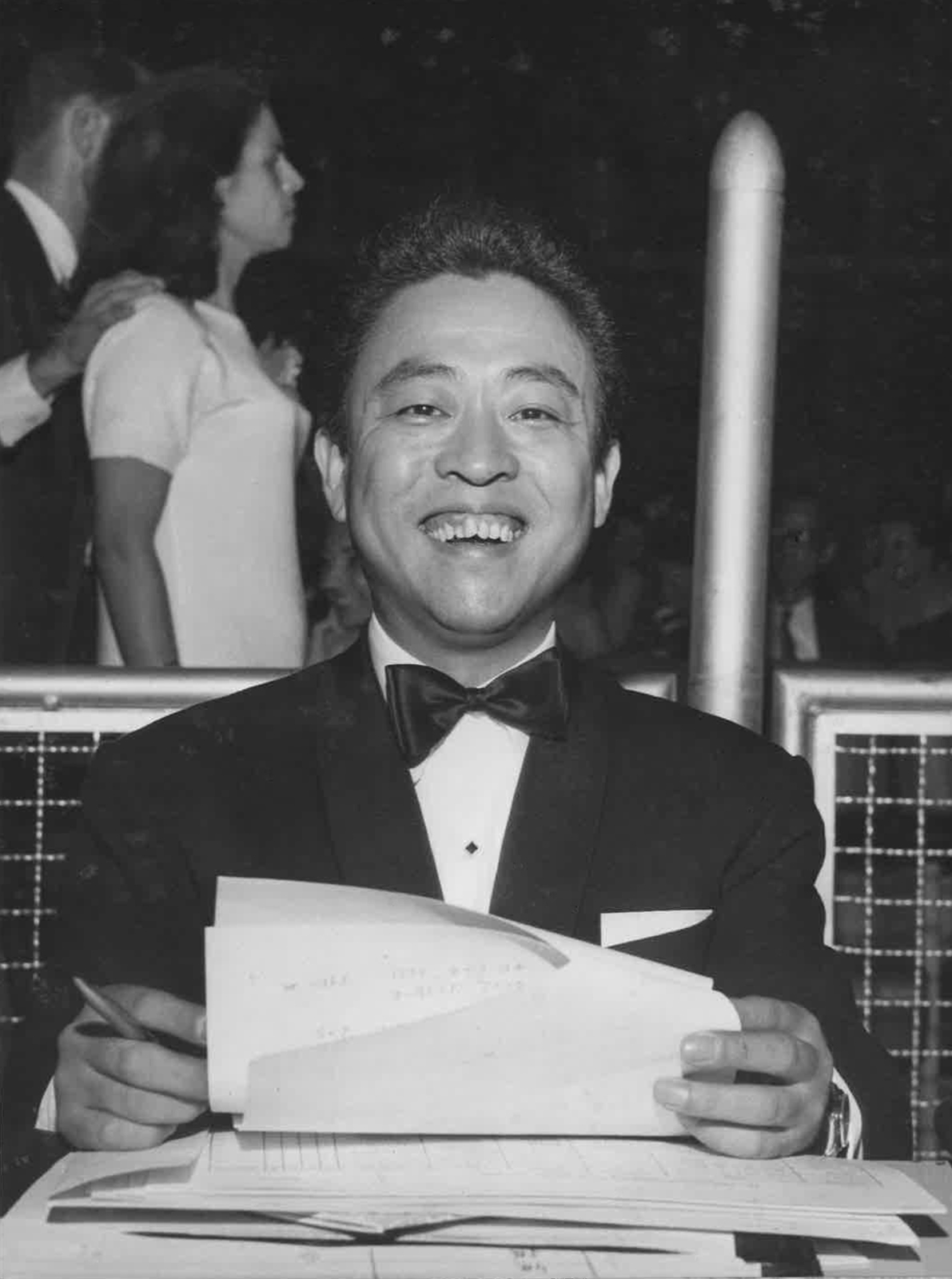
Then, on April 5, NHK Television launched Ongaku no Hana Hiraku (Wednesdays, 9:40 p.m., 50 minutes), directed by Norihiko Suemori. Hosted by Tatsuya Mihashi and Naomi Sagara, with regular appearances by Naozumi Yamamoto, Robbie Wada and his group, and Let’s Go, the program attracted attention for its ambitious musical scale. Hachidai Nakamura Quintet and a full orchestra provided the instrumental performances, while the Tokyo Mixed Chorus supplied the choral accompaniment. Each episode explored a different musical theme with remarkable creativity, and one memorable installment even featured enka singers performing popular standards in an entertaining yet highly experimental format. Despite its high artistic quality, however, the program came to an end on December 27.
That same year, Hachidai completed a new family home in Magome, Tokyo. Designed with a distinctive polygonal structure to allow every room to receive abundant natural light, the house astonished everyone who visited.
On December 19, 1968, his third daughter, Ayuko, was born.
Early in 1969, Hachidai began preparations for NHK Television’s Stage 101. The program had long been envisioned by NHK director Norihiko Suemori, who had laid the foundations for Japan’s television variety shows through Yume de Aimashou. His ambition was to introduce the essential elements of Western musical theatre and television variety entertainment into Japanese broadcasting on a truly professional scale. The cast was carefully selected from young performers who could not only sing and dance but were also deeply committed to music. Among them were members of existing vocal groups such as Sing Out and The Baron, both of which had already established distinctive musical identities.
Training for the selected performers began in June. Shoji Wada was responsible for vocal instruction, choreography was entrusted to Kumi Nakagawa and Chacha Endo, and Hachidai served as musical director. In addition to singing and dancing, the participants received rigorous instruction in professional etiquette, reflecting Suemori’s uncompromising standards.
During this period, on July 25, Sing Out performed “Namida o Koete” at Yamaha’s First Nemu Popular Song Festival, where the group won the Grand Prix. A pilot edition of Stage 101 was broadcast on November 3, featuring guest appearances by several performers closely associated with Hachidai, including Haruo Minami, Kiyoshi Atsumi, Hitoshi Ueki, and Yoshiko Ishii. The regular series premiered on January 10, 1970 (Wednesday, 8:00 p.m., 60 minutes). As with his previous television work, many of Hachidai’s newly composed songs for the program were subsequently released on record.
Although the program came to an end on March 31, 1974, it produced numerous singers, entertainers, and musicians, and continues to enjoy a devoted following to this day.
On October 19, 1970, The Hachidai Nakamura Works Recital was presented at Bunkyo Public Hall. The recital was organized in three parts. It featured the premieres of two large-scale orchestral works that Hachidai had long hoped to compose: Symphony in E Major and Overture to A.D. 2000, both performed by the Japan Philharmonic Orchestra under the baton of Koki Tezuka. The third part, Song of Water (a twelve-movement work conceived by Shuntaro Tanikawa), unfolded as a magnificent musical pageant in which the entire cast sang and danced together. Izumi Yukimura’s soaring vocals, the brilliant orchestral accompaniment, and the stage debut of the members of Young 101 combined to create an unforgettable atmosphere of youthful energy. A recording of the performance was broadcast on Bunka Hoso at 8:30 p.m. on November 1. Also appearing were Hideo Kanze and Orchestra 101—an ensemble formed by expanding Hachidai Nakamura Quintet with several additional musicians. The production was directed by Rokusuke Ei.
That same year, Izumi Yukimura’s “Namida” won the Grand Prix at the Second Nemu Popular Song Festival and also received the Best Vocal Performance Award at the First Tokyo International Popular Song Festival, later known as the World Popular Song Festival.
“This is one of my favorite songs, and such a truly great song. Whenever I finish singing it, I feel a profound sense of fulfillment—as if I have truly sung from the bottom of my heart. Even now, I continue to perform it on stage in response to requests from the fans who have supported me all these years.”
— Izumi Yukimura
The following year, Junhiro Shimokawa, an NHK television director who had known Hachidai since the days of Yume de Aimashou, approached him with a proposal for the program he was then producing, NHK’s Hiru no Present (Monday–Friday, 12:20 p.m., 25 minutes). The concept was to invite a different composer each day of the week and build the program around that composer’s individual musical style. In addition to appearing on the program himself, Hachidai was entrusted with overall musical direction. Entitled Composers in Person, the series featured an extraordinary lineup: Hachidai on Monday, Kuranosuke Hamaguchi on Tuesday, Taku Izumi on Wednesday, Kunihiko Suzuki on Thursday, and Hiroshi Miyagawa on Friday. The five programs were broadcast from February 8 through February 12, 1971.
Among Hachidai’s activities during this period, one performance stood out in particular. At the Third Nemu Popular Song Festival, Hachidai himself sang “Taiyo to Tsuchi to Mizu o.” Performed with a boys’ and girls’ choir, the song astonished the audience and received the festival’s Special Award.
“The conventions of music—whether 3/4 and 4/4 time, the little ‘tadpoles’ we call musical notes, or the fixed pitches of equal temperament—are nothing more than symbols that humanity has found convenient to use over the past few centuries. Human emotion surely contains durations that cannot be confined within measures, and pitches that cannot be fully expressed by notes on a page.
“Lately, I have felt a strong desire to cast aside all these basic conventions of music and devote myself to creating songs that everyone can truly sing together from the heart.”
Around this time, Hachidai’s health began to deteriorate. Years of overwork and an irregular lifestyle caused his diabetes to become increasingly severe. Following a medical examination, he was hospitalized. From that point onward, he battled the disease for the rest of his life, enduring repeated hospitalizations and recoveries.
“I tried to be careful by cutting back on work, but one day I decided to travel alone around the world for an entire month. Surrounded by foreign languages wherever I went, I hardly spoke to anyone during the trip, and I gradually became consumed by my own thoughts. I even started thinking that the whole world was wrong. (Laughs.) It was a state of depression. When I returned to Japan, I quit all my work. Even though I had an ordinary family—a wife and four children—I suddenly insisted that city life was driving people mad and that we should move to the countryside. In a sense, I was mentally unwell. About six months later, I became much calmer, and it finally occurred to me that perhaps my diabetes had been the cause.”
— Kurashi to Kenko, March 1983
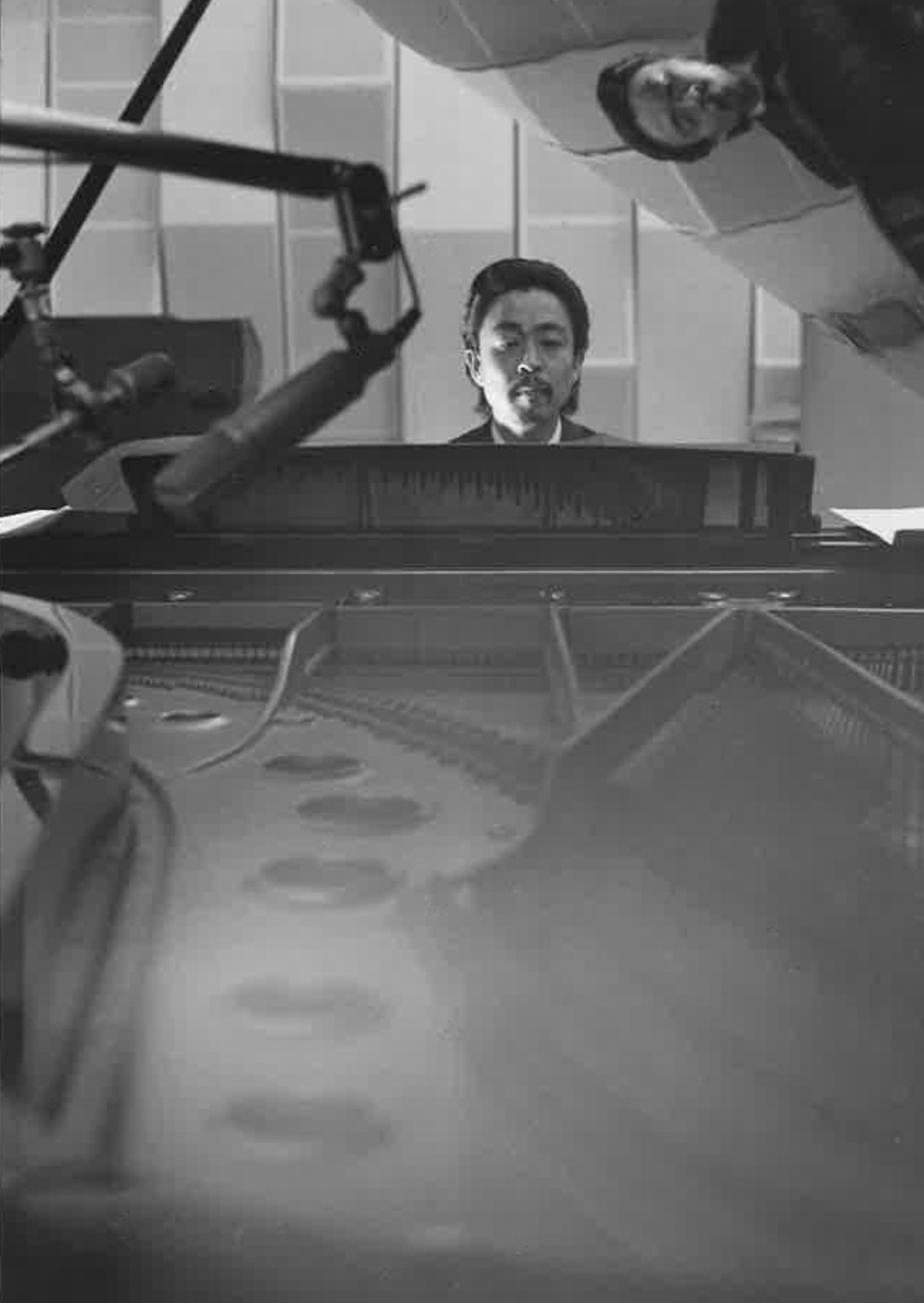
Despite his illness, Hachidai never ceased to be a pianist. On January 28, 1974, he appeared in Blow Blow Big Four, held at the Shiba Postal Savings Hall, where the group recreated the atmosphere of the classic radio program Torys Jazz Game. Hosted by Roy James and opening with the theme song “Lover,” the performance moved longtime fans to tears. The reunion drew a rapturous response from the audience.
Hachidai Nakamura Quintet also continued to perform during this period. Jimmy Takeuchi and Takeyoshi Igarashi succeeded one another on drums, while Morihisa Izaki, Kozo Sugaya, and Ikuo Shiosaki took turns on guitar. Hidehiko Matsumoto also appeared regularly as a guest performer.
Around the same time, Hachidai served as musical director for the Middle-Aged Three—Rokusuke Ei, Akiyuki Nosaka, and Shoichi Ozawa—and later accompanied Ei on concert tours after he embarked in earnest on a singing career. These performances took the group throughout Japan, and on occasion Kyu Sakamoto joined them as a guest. The album Rokusuke: Sono Sekai, released in August 1974, grew directly out of these performances.
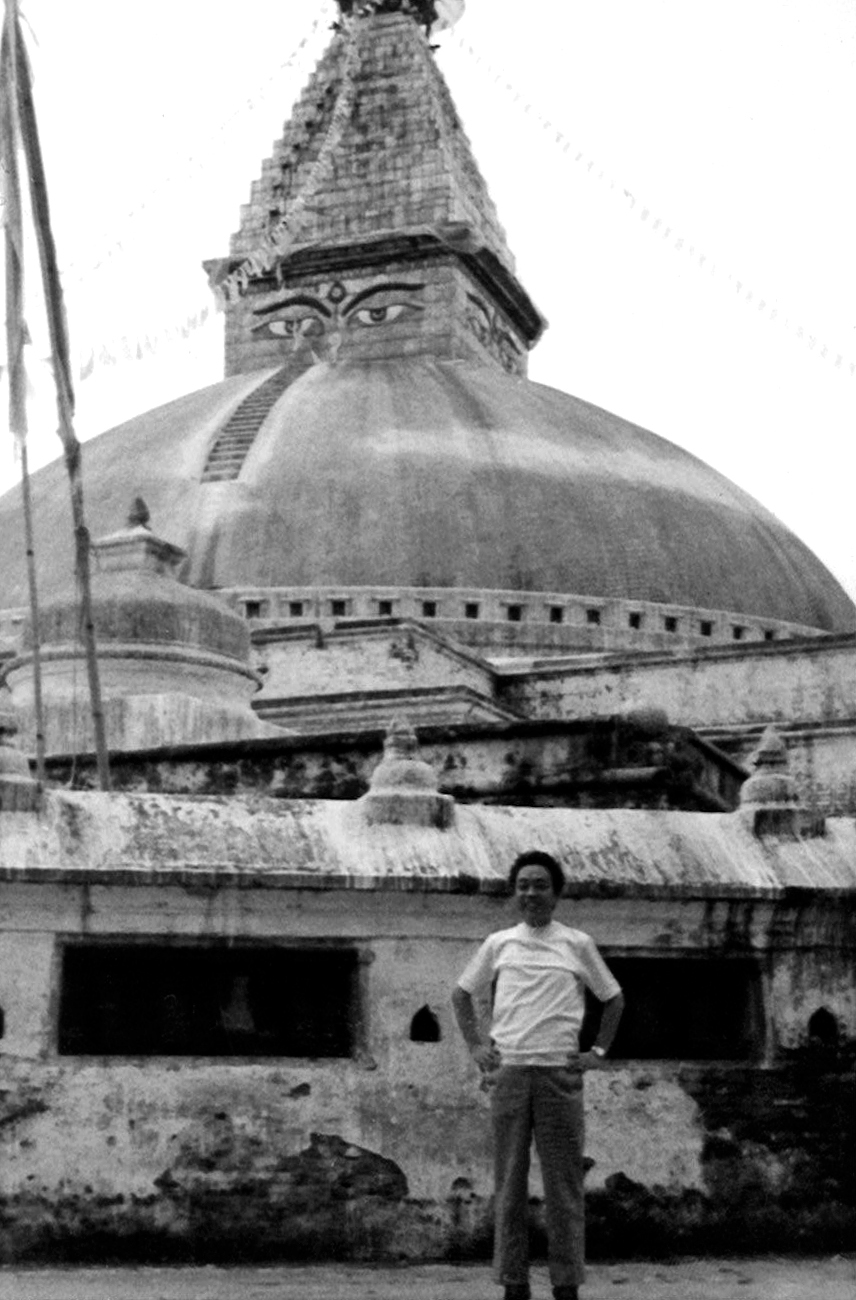
In April 1976, Hachidai was invited to China together with Ikuma Dan, Toru Takemitsu, Kyoko Ito, and others. During their two-week stay, they attended concerts throughout the country. Hachidai was particularly impressed to learn that the huqin, one of China’s traditional bowed instruments, was still being continually refined. He also expressed admiration for the high standard of Chinese orchestras. At the same time, he witnessed the uncompromising reality that, no matter how technically accomplished a performer might be, anyone who failed to win the audience’s applause would simply not be offered work. Reflecting on this experience, he later wrote:
“Whether one is a musician or engaged in any other profession, one’s work exists only insofar as it serves other people—that is, society as a whole. A musician who cannot earn even a single round of applause, who fails to move the hearts of others in any way, is not worthy of being called a musician. Such a person should give up music that very day and immediately turn to another profession in which he or she can truly contribute to society.”
In September 1977, the Original Big Four reunited for a concert at Shibuya Public Hall, bringing together George Kawaguchi, Hidehiko Matsumoto, Hachidai, and Mitsuru Ono for the first time in many years. As the four musicians swung with undiminished energy, even younger audience members who had never witnessed the original Big Four were moved to respond with generous and enthusiastic applause. A recording of the concert was released by Phonogram in November under the title Original Big Four.
Nagashiba, who rejoined Hachidai Nakamura Quintet that same year, later recalled the circumstances:
“The reason I left the Quintet was that studio work had become increasingly busy. I was never the type who could juggle two careers, so I immediately went to speak with Hachidai. He simply said, ‘Then you should leave,’ and that was that.
Afterward there was a gap of about seven years during which I hardly saw him. During that time I made my living doing studio work, bought a house, and my life finally became stable. Then one day I ran into Hachidai again at a recording studio while working on one of his film scores or something similar. I told him that, thanks to all the studio work, life had finally settled down. He simply said, ‘Then come back.’ He was never someone who wasted words.
Although there was that long break, I ended up working with him for another twenty-six or twenty-seven years, right up until the day he passed away.”
— Shoji Nagashiba
In 1979, work began on a new album by the celebrated 6–8 partnership of Rokusuke Ei and Hachidai, joined by Kyu Sakamoto to form the legendary trio. It had been sixteen years since the three had collaborated on an entirely new project, and they devoted themselves wholeheartedly to the recording.
Throughout the recording sessions, which took place between March 2 and April 19, work in the studio invariably began late at night and continued until dawn. This schedule was dictated by the fact that Sakamoto was then hosting Fuji Television’s live nightly program Star Senichiya. As soon as the broadcast ended, he would hurry directly to the recording studio and begin work.
The album was titled 689. As expected, all the lyrics were written by Ei, while Hachidai composed and arranged every track. Among the selections was a self-cover of “Hitoribocchi no Futari,” which, at Hachidai’s insistence, was recorded in a single take, with both the vocals and instrumental performance performed live simultaneously.
689 was Sakamoto’s first album consisting entirely of newly written original songs. His previous albums had largely been collections of previously released singles or thematic compilation albums.
Following the album’s completion, the trio continued to perform together. Beginning in May, a series of promotional concerts entitled 689 Club was launched for members of the press. Similar performances were held several more times at different venues. Following the album’s release on June 20, the 689 Reunion Concert took place at Nakano Sun Plaza on September 9, with additional performances later held in Sapporo, Kanazawa, Osaka, and other cities.
Meanwhile, Hachidai’s struggle with illness continued. He underwent a lengthy stay at Amakusa Hospital in Kumamoto. Although frustrated by the slow pace of his recovery, he gradually came to understand the serious dangers posed by the complications of diabetes and resolved to devote himself fully to treatment.
“When I was hospitalized, there was a patient in very serious condition. At mealtimes, because he could hardly see, he would hold his food right up in front of his eyes, desperately trying to make out what it was. Seeing that made a tremendous impression on me. I thought to myself, ‘I never want to end up like that.’ Only then did I finally find the determination to commit myself to treatment.”
— Kurashi to Kenko, March 1983
Around that time, director Junhiro Shimokawa, who had been transferred to NHK Osaka, became something of a caretaker for Hachidai as he continued performing while battling illness. Shimokawa later recalled that whenever Hachidai came to the Kansai region for work, he accompanied him whenever possible.
“Whenever he saw me, he would say, ‘Let’s have a drink.’ Of course, I would refuse, but then he would tell me there was a piano bar near the hotel where he was staying and insist that I come along. It was the kind of place where customers could sing to live piano accompaniment, and once Hachidai showed up, everyone started asking him to play the piano.
So he accompanied several of the customers, and then he said, ‘Shimo-chan, why don’t you sing something too?’ (Laughs.) My voice is quite low, but he instantly adjusted to my key. And then there was the matter of timing—you know how a singer might come in a little late or hold a phrase a little longer? No matter what I did, he followed me perfectly. That was when I realized, in my own way, that this man was truly extraordinary.”
— Junhiro Shimokawa
In 1984, Hachidai was invited as a guest to the First Los Angeles World Music Festival in the United States, where he received a standing ovation as the composer of “Sukiyaki.” His regular performances at Shibuya Jean-Jean, entitled Rokusuke Ei + Hachidai Nakamura Live, were also well received. Performing in close proximity to their audience, the two created a warm and intimate atmosphere. A recording of these performances was subsequently released as a live album.
At the album-release concert held on August 7, 1985, Kyu Sakamoto was seen in the audience. After the performance, Hachidai and Sakamoto shared a drink together, just the two of them.
Five days later, the Japan Airlines flight carrying Sakamoto crashed.
“The development of modern civilization made me think, ‘How sad.’ Kyu-chan was already gone, and yet his bright, vibrant voice continued to echo in the ears of those of us who were grieving. … Of all the people who came to pay their respects, Hachidai Nakamura looked the saddest. I held Hatchan’s hand the entire time.”
— From My Friends by Tetsuko Kuroyanagi
Despite his illness, Hachidai continued to appear regularly at clubs such as Drum in Akasaka and Royal Drum in Ikebukuro. He also continued performing in Ten O’Clock Theatre, held at 10:00 p.m. on the first Monday of every month, which featured a wide variety of guests, including Tony Tani and Taro Maruse. At the same time, he continued to accept commissioned work, including composing the music for Yomiuri Television’s Tuesday Suspense Theatre, directed by his friend Nobuyuki Kosaka.
At the end of 1986, he purchased the Bösendorfer grand piano he had long dreamed of owning.
“Hachidai was someone far above us, but to those of us in the Quintet, he was first and foremost a pianist. Of course, he was also a great composer, but above all, he was a great pianist. In his later years, I came to think of him more and more simply as a pianist.
Even when walking had become genuinely difficult for him, the moment he sat down at the piano, he would suddenly straighten up and come alive. He truly was no ordinary person.”
— Shoji Nagashiba
“There was a Kawai competition, and Hachidai served as chairman of the jury for the national finals. I was one of the judges as well. It was held in Nagoya during the summer, and it was unbearably hot. Hachidai was drenched in sweat, and I thought, ‘This isn’t good.’
I had brought a spare shirt, so I handed it to him and said, ‘Please put this on.’ He kept saying, ‘No, no, you don’t have to,’ but he put it on anyway. He wore it for the rest of the day, and when we parted, I never asked for it back.
A few months later, I received a telephone card with the message, ‘I’m feeling better now.’ In the photograph on the card, Hachidai was wearing the very shirt I had lent him. (Laughs.) It was adorable. (Laughs.) He must have thought I had given it to him. (Laughs.)”
— Kunihiko Suzuki
True to the message on the telephone card, Hachidai regained his health. In 1987, he resumed work as musical director for productions such as Theatre Echo’s If You’re Going to Sing, Make It a Love Song and the Shochiku Revue Company’s Summer Dance, while also returning to concert activities with the Big Four and the Hachidai Quartet. Alongside his work with Rokusuke Ei, he energetically presented joint concerts with James Miki and Tomoko Matsushima. The year also included extensive overseas travel, including performances in Singapore, a lecture tour of Tianjin and Beijing in China, and an invited visit to Australia.
In 1988, under the slogan “Hachidai’s Year ’88,” Hachidai pursued an even more ambitious performance schedule than the year before. In addition to a return engagement in Singapore, he fully resumed the 6 + 8 Concerts with Rokusuke Ei, giving eighteen performances. These concerts were presented not only throughout Japan but also in Jakarta, Kuala Lumpur, San Francisco, and other cities. Wherever he traveled, Hachidai invariably visited the local Japanese school. Drawing upon his own childhood experience at the Japanese school in Qingdao, he spoke to the students in simple, heartfelt terms about the unique opportunities that came with living abroad and the importance of taking pride, even after returning to Japan, in having experienced life in another country.
In 1989, the 6 + 8 Concerts were presented at twenty-six venues throughout Japan as well as on Guam. Around this time, in addition to his appearances with 6 + 8 and the Big Four, Hachidai also began accepting speaking engagements on his own. In lectures for music educators, he spoke passionately to many young teachers about the doubts he had harbored regarding music education since childhood and shared his own philosophy of music.
In 1990, Hachidai made frequent visits to his hometown of Kurume. In addition to concerts with the Kurume Music Association Chorus, led by his close friend Shiro Honma, he made recordings with the Bridgestone Wind Orchestra. During breaks in his concert schedule that year, he also traveled to France and Belgium, where he was able to experience live European music once again after many years. In Taiwan, he delighted in one of his favorite pleasures—authentic Chinese cuisine.
As 1991 began, Hachidai found himself spending increasing amounts of time in the hospital. Around this time, he was commissioned to compose the theme song for Kagawa Prefecture for the 48th Eastern Shikoku National Sports Festival, jointly hosted by Kagawa and Tokushima Prefectures in the summer and autumn of 1993. Together with lyricist Michio Yamagami, he visited the region for research. Yamagami later recalled being overwhelmed by Hachidai’s strength of spirit as he continued his work despite looking deathly pale. The resulting song, “Aoi Kuni,” performed by Cherish, was completed in the spring of that year.
On November 3, Hachidai and Yamagami entered “Boku-tachi wa Kono Hoshi de Deatta,” sung by Shigeru Matsuzaki and the Segami Elementary School Choir of Fukushima City, in the First Yuji Koseki Memorial Music Festival. It received the festival’s Gold Prize. The work was so impressive that many of the other composers participating in the festival openly praised the enduring brilliance of Hachidai’s melodies.
That same year, his eldest daughter, Satoko, was married. Before the many invited guests, Hachidai performed “Wedding Dress” at the piano. The radiant smile on his face left a lasting impression on everyone in attendance.
From January 9 through 11, 1992, Hachidai Nakamura: Fifty Years as a Musician / Rokusuke Ei: Forty Years in Broadcasting — Ano Uta Kono Uta: Yume de Aimashou was presented at Theatre Cocoon. Every song in the concert was selected from the “Song of the Month” series originally featured on NHK’s Yume de Aimashou. Hosted by Rokusuke Ei and Yasuko Endo, the cast included original Yume de Aimashou regulars Hiroko Nakajima, Sumiko Sakamoto, Yasuo Tanabe, and Yuzuko Kokonoe, together with former Young 101 members Seiji Tanaka and Akeko Izumi. Accompanied throughout by the Hachidai Quartet, the concert proved a fitting celebration of Hachidai’s fifty-year musical career. The performance was later broadcast by NHK, and in a thoughtful gesture, the network assigned the same television cameraman who had filmed the original Yume de Aimashou broadcasts many years earlier.
Following the concerts, however, Hachidai was hospitalized once again in February.
Even so, he had a portable keyboard and manuscript paper brought into his hospital room so that he could continue developing the musical he had been planning with Rokusuke Ei and compose the song he had promised Tetsuko Kuroyanagi after receiving her heartfelt letter of encouragement.
On February 11, Hachidai Nakamura and His Wonderful Friends, featuring Rokusuke Ei, Hidehiko Matsumoto, Tomoko Matsushima, and others, was presented at Omiya Sonic City. That day, Hachidai traveled directly from the hospital in Tokyo to the concert hall.
Although he was in no condition to perform, he summoned every ounce of strength he had and fulfilled his role at the piano until the very end.
It would prove to be the final performance of his life.
“Hachidai Nakamura, the composer best known for such hit songs as “Ue Wo Muite Arukou,” “Kuroi Hanabira,” and “Konnichiwa Akachan,” passed away from heart failure at 7:04 p.m. on June 10 at Tokyo Women’s Medical University Hospital in Shinjuku, Tokyo. He was sixty-one years old.”
— Asahi Shimbun, June 11, 1992
“To me, Hachidai Nakamura was the pianist I respected above all others. He was one of the world’s cultural treasures, and I only wish the Japanese government had awarded him the Order of Culture. He was that extraordinary—not only as a composer, but above all as a pianist.”
— George Kawaguchi
More than one thousand mourners attended his funeral on June 13. In accordance with his family’s wishes, no eulogies were delivered. Instead, recordings of Hachidai’s own piano performances were played quietly throughout the service.